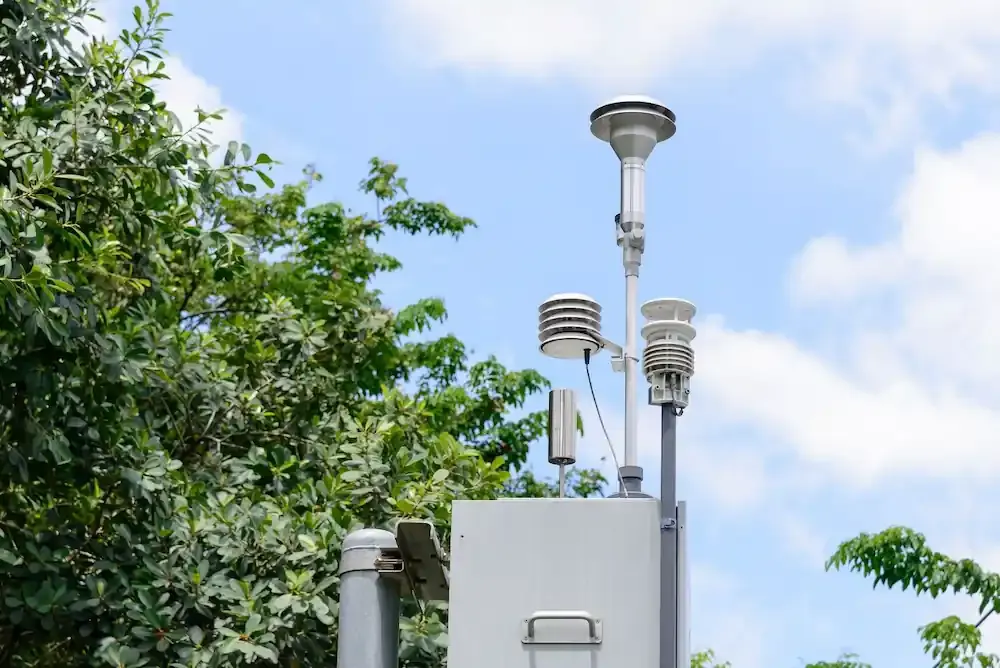
Ghana's monitoring network tracks four key pollutants linked to the greatest health burden.
PM₂.₅
Fine Particulate Matter
Particles 2.5 micrometres or smaller, about 30 times finer than a human hair. At this size they bypass the nose and throat entirely.
Common Sources
Vehicle exhaust
Biomass and waste burning
Industrial emissions
Harmattan dust
Health Impact
Enters the bloodstream directly. Linked to heart disease, stroke, lung cancer and low birth weight. The single most harmful air pollutant.
WHO guideline: 5 µg/m³ annual (WHO 2021)
PM₁₀
Coarse Particulate Matter
Particles up to 10 micrometres: dust, pollen, mould spores and sand. Large enough to be filtered by the nose but can still reach the airways.
Common Sources
Road dust and construction
Mining operations
Agricultural burning
Saharan Harmattan
Health Impact
Irritates the nose, throat and airways. Triggers asthma attacks and respiratory infections. Peaks sharply during Harmattan season.
WHO guideline: 15 µg/m³ annual (WHO 2021)
NO₂
Nitrogen Dioxide
A reddish brown gas produced by high temperature combustion. A reliable marker for traffic related air pollution in urban areas.
Common Sources
Vehicle engines (diesel)
Power generation
Cooking with gas/kerosene
Industrial processes
Health Impact
Inflames the lining of the airways, reducing resistance to infection. Long term exposure is linked to asthma development, especially in children.
WHO guideline: 10 µg/m³ annual (WHO 2021)
O₃
Ground Level Ozone
Not the protective ozone in the upper atmosphere. Ground level ozone forms when vehicle and industrial emissions react in strong sunlight.
Common Sources
NOT emitted directly
Forms from NOx + VOCs
Peaks in hot dry season
Highest midday to afternoon
Health Impact
Causes chest pain, coughing and throat irritation. Reduces lung function, even in healthy people. Particularly harmful during Ghana's dry season.
WHO guideline: 60 µg/m³ peak season (WHO 2021)
Public Health
How air pollution affects the body
Air pollution is now the world's largest single environmental health risk. The effects depend on the pollutant, concentration, and duration of exposure.
Short term exposure
Hours to days
Eye, nose and throat irritation
Headaches and dizziness
Coughing and shortness of breath
Worsened asthma symptoms
Reduced physical performance
Long term exposure
Years of exposure
Reduced lung capacity
Chronic obstructive pulmonary disease (COPD)
Cardiovascular disease and stroke
Lung cancer
Cognitive decline in older adults
Most vulnerable groups
Elevated risk
Children (developing lungs)
Elderly (reduced immunity)
Pregnant women and unborn
People with asthma or COPD
Outdoor and manual workers
Daily protection guide
AQI 0–50
Normal outdoor activities. A great day to exercise outside.
AQI 51–100
Sensitive groups reduce prolonged outdoor exertion.
AQI 101–150
Limit outdoor exercise. Consider a mask if outdoors long.
AQI 151+
Avoid outdoor activity. Stay indoors, keep windows closed.
Ghana Context
Major Pollution Sources in Ghana
Air pollution in Ghana has distinct local drivers. Understanding these sources helps communities and policymakers take targeted action.
Harmattan Dust
November to March
A dry north-east trade wind that carries Saharan dust across West Africa each dry season. PM10 and PM2.5 levels surge across all regions, with the Upper East and Northern regions worst affected. Visibility can drop to near zero during peak events.
Harmattan can push 24-hour PM2.5 above 150 µg/m³ in northern Ghana.
Charcoal and Biomass Cooking
Year-round
More than 75% of Ghanaian households cook with charcoal, wood, or crop waste. Burning biomass in enclosed or poorly ventilated kitchens produces high concentrations of PM2.5 and carbon monoxide, disproportionately affecting women and children.
Household cooking fires are the single largest source of indoor air pollution in Ghana.
Open Burning and Waste Fires
Dry season peaks
Where formal waste collection is absent, open burning is the default disposal method. Agbogbloshie in Accra, one of the world's largest e-waste sites, produces toxic smoke from burning cables and electronics. Agricultural residue burning after harvest adds large smoke plumes across rural areas.
E-waste burning at Agbogbloshie releases dioxins, furans, and heavy metal particles.
Road Traffic Emissions
Year-round, peaking in rush hours
Accra, Kumasi, and Tema have dense traffic dominated by old imported diesel and petrol vehicles. Older engines emit far more nitrogen dioxide and black carbon than modern vehicles. Congested intersections and bus stations have the highest roadside PM2.5 readings.
Ghana's vehicle fleet is among the oldest in West Africa, with many vehicles over 15 years old.
Industrial Sources: Tema and Accra
Year-round
The Tema Industrial Area hosts oil refining, steel production, cement, and chemical manufacturing. Emissions include sulphur dioxide, nitrogen oxides, and fine particles. Prevailing south-west winds in the rainy season can carry plumes into eastern Accra communities.
Tema is Ghana's main industrial zone, home to over 60% of the country's manufacturing activity.
Mining: Western Region and Beyond
Year-round
Large-scale gold mining in the Western Region and widespread artisanal small-scale mining (galamsey) generate coarse dust from open pits and release mercury vapour during processing. Dust from unsealed mining roads affects nearby villages. Obuasi and Tarkwa communities are among the most exposed.
Ghana is Africa's top gold producer. Artisanal mercury use is a growing air and water quality concern.
What you can do
Switch to LPG or improved cookstoves
Reduces indoor PM2.5 by up to 70% compared with open wood fires.
Use public transport or walk
Every private car journey removed from Accra streets cuts roadside NOx and fine particles.
Wear an N95 on high-pollution days
Effective during Harmattan season and near major roads or waste sites.
Avoid burning waste or crop residue
Report illegal open burning to EPA Ghana on their hotline 0800-800-800.
References & Sources
World Health Organization. WHO Global Air Quality Guidelines: Particulate Matter (PM₂.₅ and PM₁₀), Ozone, Nitrogen Dioxide, Sulfur Dioxide and Carbon Monoxide. Geneva: WHO; 2021.
Link
Health Effects Institute. State of Global Air 2023. Special Report. Boston: Health Effects Institute; 2023.
Link
IARC Monographs Volume 109. Outdoor Air Pollution. Lyon, France: International Agency for Research on Cancer; 2016.
Link
GBD 2019 Risk Factors Collaborators. Global burden of 87 risk factors in 204 countries and territories. Lancet. 2020;396(10258):1223–1249.
Link
Environmental Protection Agency Ghana. National Ambient Air Quality Standards. Accra: EPA Ghana; 2019.
Arku R.E. et al. Characterising air quality in two low-income neighbourhoods in Accra, Ghana. Science of The Total Environment. 2020;720:137556.
Link
Wiedinmyer C. et al. The open-source fire inventory from NCAR (FINN): a high resolution global model to estimate the emissions from open burning. Geoscientific Model Development. 2011;4(3):625–641.
Gilbert J, Aryee J.N.A., Adjei M.J., Mensah C., Quagraine K.T. Machine learning-based assessment of aerosol optical depth over Ghana, West Africa using MODIS satellite data. PLOS Climate. 2025;4(8):e0000651.
Link
AQI categories and thresholds used on this platform follow the US EPA AQI calculation methodology applied to PM₂.₅ measurements. Health guidance is informational and does not replace advice from a medical professional.